D&O, Liability and Flood Coverage for Florida Associations: Three Policies, Three Different Jobs
A Florida association law firm explains how D&O, general liability and flood policies differ, and Florida's condominium statute names each as optional coverage.
 By Tony Roca, attorney licensed in Florida and Tennessee, Florida Supreme Court Certified Circuit Civil and Family Mediator
When a condominium or homeowners’ association buys insurance, the policies it holds are not interchangeable. A November 24 article from the Florida Condo & HOA Law Blog, published by the Becker firm, sorts three of them by the kind of claim each is built to answer 1. The distinctions matter in disputes, because a claim sent to the wrong policy can delay a defense or end in a denial.
Directors and officers coverage
Directors and officers (D&O) insurance generally protects board members, officers and often the association itself against claims about how the association was run. The article lists breach of fiduciary duty, negligent decision-making, selective enforcement of the governing documents and architectural review disputes as typical examples 1. It gives a practical illustration: an owner says the board wrongly denied a modification request, or enforced a restriction against one owner while overlooking the same conduct by others 1.
Covered claims can bring a defense and payment of covered settlements or judgments, but only within policy limits, deductibles and exclusions 1. The article names fraud, criminal conduct and intentional misconduct among common exclusions, and it says coverage turns on the actual policy language and endorsements 1. It recommends that boards confirm who counts as an insured, whether the association has entity coverage, what deductible or retention applies, whether defense costs erode the limits, and which exclusions could matter 1.
Florida’s condominium statute treats this coverage as optional. Under section 718.111(11)(e), the association “may also obtain and maintain liability insurance for directors and officers, insurance for the benefit of association employees, and flood insurance for common elements, association property, and units” 2. The same statute separately requires insurance or fidelity bonding for people who control or disburse association funds, and it requires the bonding to cover the maximum funds in custody at any one time 2.
Commercial general liability
Commercial general liability coverage addresses third-party claims for bodily injury, personal injury or property damage tied to the association’s operations or premises. Among the firm’s examples are a guest who falls on a lobby floor left wet, an owner who catches a foot on a broken stretch of walkway, a faulty stair railing, a tree limb that drops, and accidents around the pool, clubhouse or fitness room 1.
The article draws the line between this policy and D&O coverage with a maintenance example. A trip-and-fall caused by allegedly negligent upkeep points toward general liability. A complaint that the board made a poor decision, such as failing to hire a contractor for that upkeep, is more likely a D&O matter 1. A single dispute can touch both policies. General liability policies also carry exclusions for employee injuries, professional services, certain contractual liabilities and property under the insured’s control, so the article advises reading them before assuming a claim is covered 1.
Flood coverage
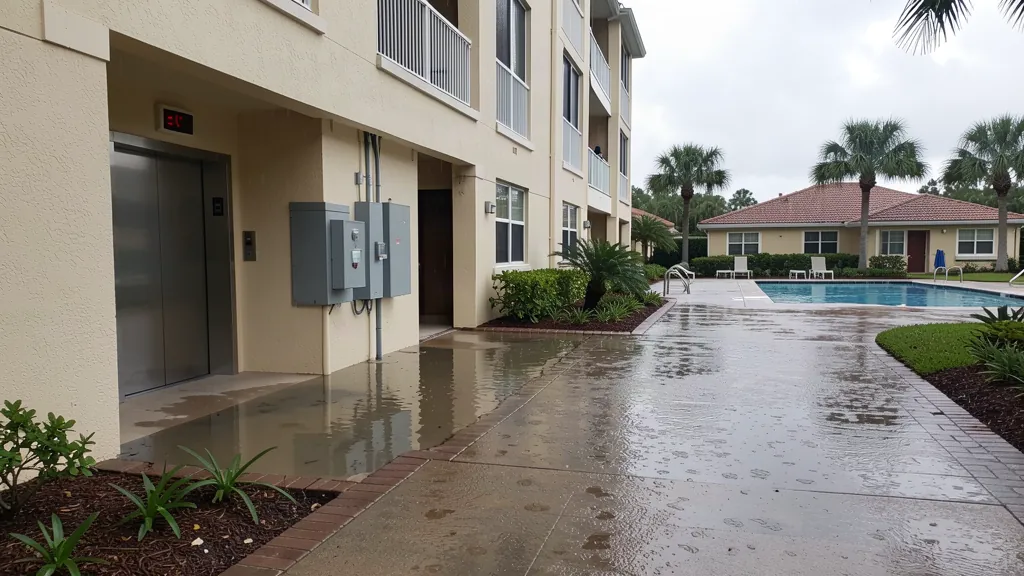
Flood insurance pays for direct physical damage to insured property from a covered flood. Depending on the policy terms, the covered property can reach from the structure and its foundation to wiring, pipes, elevators, mechanical gear and contents the association owns 1.
The article stresses a point that often surprises owners: not every water loss is a flood loss. A roof leak, broken pipe, sewer backup or wind-driven rain may fall under different coverage and may not be reached by flood insurance. It also notes that National Flood Insurance Program policies and private flood policies can differ significantly 1. Associations are told to confirm which buildings are insured, whether contents are included, and whether limits fit a major loss 1.
Why it matters in a dispute
The article’s recommended annual review is to compare limits and deductibles against current risk, identify key exclusions and reporting requirements, find risks that are uninsured or underinsured, confirm who is insured under each policy, and keep records that would support a claim 1.
For attorneys and adjusters, the useful point is classification. Whether an owner’s complaint, an injury or a water loss lands under D&O, general liability, flood or the association’s property policy can decide who is defending the claim and who pays. A disagreement over that classification is the kind of issue a mediation can sometimes narrow before positions harden.
Counsel looking for a certified mediator can check Tony Roca’s live availability and book a mediation by Zoom statewide.
Sources
- Our Association Just Purchased D&O, Liability, and Flood Insurance. What Does Each Cover? (opens in a new tab), Florida Condo & HOA Law Blog (Becker), November 24, 2026.
- Florida Statutes section 718.111, The association (opens in a new tab), The Florida Senate.
This article provides general information as of November 27, 2026, not legal advice for any particular situation.